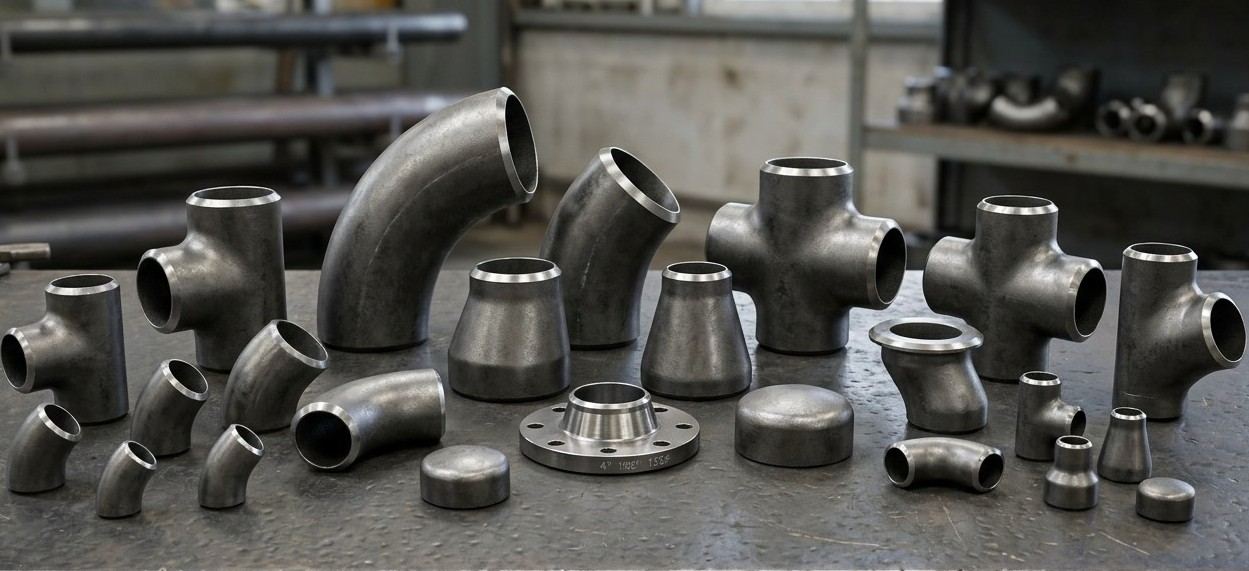
Buttweld fittings are widely used in piping systems that handle liquids, gases, steam, chemicals, and other industrial fluids. These fittings are welded directly to pipes, creating a strong and permanent connection.
They are commonly used in oil and gas, petrochemical, chemical processing, power generation, water treatment, and manufacturing industries. Their smooth internal surface and strong welded joints make them suitable for systems that require reliable flow and leak resistance.
Understanding the different types of buttweld fittings helps engineers, contractors, and buyers select the right fitting for each piping application.
What Are Buttweld Fittings?
Buttweld fittings are pipe fittings designed to connect, redirect, branch, or change the size of pipes. The fitting is positioned against the pipe end and joined through welding.
Unlike threaded or socket weld fittings, buttweld fittings create a continuous connection between the pipe and fitting. This provides good mechanical strength and can help reduce turbulence.
Common types include elbows, tees, reducers, caps, and stub ends. They are available in carbon steel, stainless steel, alloy steel, and other materials selected according to operating conditions.
Main Types of Buttweld Fittings
1. Buttweld Elbows
Buttweld elbows change the direction of a piping system. Common options include 45-degree and 90-degree elbows.
A 45-degree elbow provides a gradual change in direction, while a 90-degree elbow creates a sharper turn. Long-radius elbows are often selected when smoother flow and lower pressure loss are required.
Applications include:
- Oil and gas pipelines
- Chemical processing plants
- Water treatment systems
- Industrial process piping
- Steam systems
2. Buttweld Tees
Buttweld tees allow a pipeline to split into two directions or combine flows. They have three openings and are available as equal or reducing tees.
An equal tee has openings of the same size, while a reducing tee has a smaller branch connection.
Common applications include:
- Process piping
- Water distribution
- Chemical plants
- Cooling systems
- Compressed air lines
3. Buttweld Reducers
Reducers connect pipes with different diameters. They provide a smooth transition between larger and smaller pipes.
The two main types are concentric and eccentric reducers. Concentric reducers have a common centerline, while eccentric reducers have offset centerlines. Eccentric reducers are often used where proper drainage or prevention of fluid accumulation is important.
Applications include:
- Pump connections
- Process pipelines
- Oil and gas systems
- Water pipelines
- Fluid handling systems
4. Buttweld Caps
Buttweld caps close the end of a pipe and provide a permanent termination. They can also be used when a section of piping needs to be isolated.
They are commonly manufactured from carbon steel, stainless steel, and alloy steel.
Typical applications include:
- Pipeline termination
- Pressure vessels
- Industrial piping
- Storage systems
- Chemical processing equipment
5. Buttweld Stub Ends
Stub ends are commonly used with lap joint flanges. The stub end is welded to the pipe, while the backing flange provides the bolted connection.
This setup can simplify maintenance because the flange does not need to be welded directly to the pipe. Stub ends are useful in systems that require regular dismantling or inspection.
Materials Used for Buttweld Fittings
The material should be selected according to the pipe and operating environment.
Carbon steel buttweld fittings are widely used in general industrial piping, oil and gas applications, and water systems.
Stainless steel buttweld fittings provide better corrosion resistance and are commonly used in food processing, chemical plants, pharmaceutical facilities, and corrosive-fluid applications.
Alloy steel fittings are suitable for demanding conditions involving high temperatures and pressures, including certain power and petrochemical systems.
Material selection should consider pressure, temperature, fluid type, corrosion conditions, and applicable piping standards.
Why Use Buttweld Fittings?
Buttweld fittings provide strong welded connections that can withstand demanding operating conditions. Their smooth internal profile can help reduce flow disruption and areas where deposits may collect.
They also provide good structural integrity in high-pressure piping systems when properly selected and welded. Their compact design makes them suitable for complex piping layouts where space is limited.
Where Are Buttweld Fittings Used?
Buttweld fittings are used across many industries.
In oil and gas facilities, they are used in pipelines, processing equipment, and transmission systems.
In chemical plants, stainless steel and alloy fittings can transport corrosive or high-temperature fluids.
In power plants, they are commonly used in steam, cooling water, and process piping.
In water treatment, they connect and redirect pipelines used for water distribution and processing.
They are also used in construction, manufacturing, shipbuilding, HVAC systems, and industrial fabrication.
How to Choose the Right Buttweld Fitting
Choosing the correct fitting requires more than selecting the pipe diameter. Consider pipe size, wall thickness, pressure rating, temperature, material compatibility, and connection requirements.
The fitting shape is also important. Elbows change direction, tees create branch connections, reducers connect different pipe sizes, and caps close pipe ends.
It is also important to choose fittings that meet the required industry standards and specifications. Correct dimensions and material compatibility help ensure a secure and reliable piping system.
Final Thoughts
Buttweld fittings are important components in industrial piping systems. Elbows, tees, reducers, caps, and stub ends each have specific functions based on the design and requirements of a pipeline.
For projects in the UAE, selecting fittings based on material, size, pressure rating, temperature, and applicable standards is essential. A reliable pipe fittings supplier in UAE, such as Mustafa Ashqar Trading LLC, can help with product selection and availability. For project-related questions, you can also contact our team.
Explore More Industrial Insights
If you want to deepen your understanding of industrial systems and engineering components, explore these related articles:
- Top 10 Signs It Is Time for a Pipe Replacement – Spot the early warning signs before a pipe failure disrupts your project.
- 8 Coupling Mistakes That Could Cost You And How To Avoid Them – Common coupling errors that lead to leaks, downtime and costly rework.
- 7 Simple Tricks to Extend the Lifespan of Your Pipes – Practical maintenance habits that keep piping systems running longer.