Flange selection is one of the most consequential decisions in any piping system design. Choose wrong, and you face leaks, structural failures, costly downtime, and serious safety risks. Choose right, and your system performs reliably for decades under demanding operating conditions.
If you are comparing weld neck flanges and slip-on flanges, this guide gives you the technical depth, real-world context, and decision clarity you need to get it right the first time.
What Is a Weld Neck Flange?
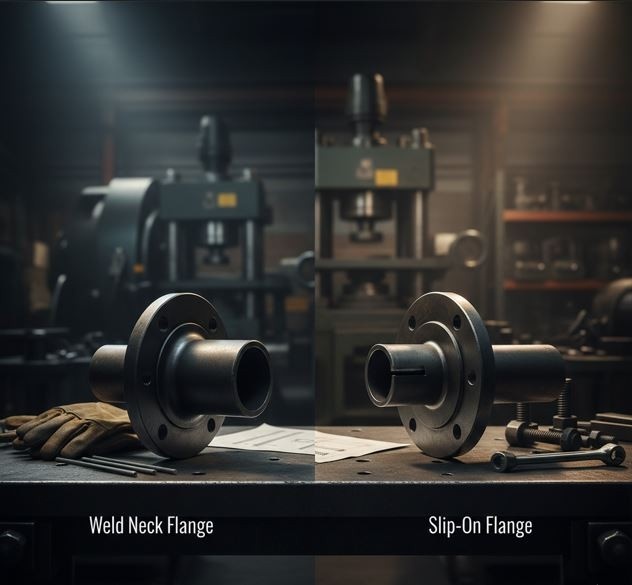
A weld neck flange features a long tapered hub that transitions gradually into the pipe wall, distributing stress evenly across the joint. It connects to the pipe via a full-penetration butt weld, which can be radiographically or ultrasonically tested to verify weld integrity under ASME B16.5 and ASME B31.3 requirements.
Where Weld Neck Flanges Perform Best
- Excel in environments with elevated pressure and high temperature
- Ideal for cyclic loading or hazardous process media
- Commonly used in oil and gas pipelines
- Suitable for petrochemical and refinery operations
- Essential in power generation steam systems
- Reliable for offshore platforms
- Applicable in cryogenic fluid handling
- Preferred wherever joint failure risk is catastrophic
.What Is a Slip-On Flange?
A slip-on flange slides over the pipe end and is secured with two fillet welds, one on the hub face and one at the internal bore. The bore is machined slightly larger than the pipe outside diameter to allow easy sliding and faster fit-up before welding..
Where Slip-On Flanges Are the Practical Choice
- Widely used in water distribution networks
- Ideal for HVAC systems
- Suitable for general utility piping
- Common in food and beverage processing lines
- Used in low-pressure chemical transfer systems
- Practical for maintenance and repair scenarios
- Preferred when replacing a weld neck flange would cause excessive cost or downtime
Weld Neck vs Slip-On Flanges: Technical Comparison
Structural Integrity and Pressure Rating
The tapered hub of a weld neck flange transfers load gradually into the pipe wall, reducing stress concentration at the joint and supporting pressure ratings up to Class 2500 under ASME B16.5. Slip-on flanges rely on two fillet welds, which are inherently less robust, and their effective pressure capacity is typically around two-thirds that of an equivalent weld neck under the same class rating.
Fatigue and Cyclic Load Performance
In systems subject to vibration, thermal cycling, or pressure surges, the butt-weld joint of a weld neck flange delivers superior fatigue resistance due to more uniform stress distribution. Slip-on fillet welds are more susceptible to fatigue cracking under repeated dynamic loading and are generally not recommended where cyclic conditions are significant.
Radiographic Testing and Code Compliance
The butt weld on a weld neck flange can be radiographically tested (RT) or ultrasonically tested (UT) to confirm internal weld integrity, as required under ASME B31.3 and API 570 for critical service. Fillet welds on slip-on flanges cannot be RT examined, which typically excludes them from Category M fluid service, lethal service designations, and any application where full weld examination is mandatory.
Installation Time and Skill Requirements
Slip-on flange installation is faster and less skill-intensive since the pipe slides through the bore and both fillet welds are deposited without demanding precision fit-up, reducing labor costs in maintenance or retrofit scenarios. Weld neck flanges require accurate pipe preparation, careful alignment, and qualified welding, but that investment directly supports long-term joint reliability in systems that are difficult or costly to access later.
Flow Characteristics
A weld neck flange can be bored to match the pipe inside diameter exactly, producing a smooth, uninterrupted flow path that minimizes turbulence and erosion in corrosive or flow-sensitive services. Slip-on flanges may introduce a minor bore step at the pipe junction, which is negligible in most general service applications but relevant in precise flow measurement or sanitary piping systems.
Material Selection for Both Flange Types
Both weld neck and slip-on flanges are available across a broad range of materials to suit different service environments. Common options include ASTM A105 carbon steel for standard pressure applications, stainless steel weld neck flanges in ASTM A182 F304 and F316 for corrosive or hygienic environments, ASTM A182 F11 and F22 alloy steel for elevated temperature applications, and stainless steel slip-on flanges or duplex and super-duplex grades for aggressive chloride conditions.
Material selection must account for the process fluid, operating temperature, external environment, and applicable code requirements. Contact our technical team to confirm the right material grade and specification for your system before ordering.
Cost Analysis: Beyond the Unit Price
Slip-on flanges are typically 20 to 40 percent cheaper to purchase than equivalent weld neck flanges, but unit price alone is not the full picture. Total installed cost includes welder labor, weld inspection, testing, and the potential expense of future maintenance or failure. In low-pressure utility systems, slip-on flanges offer genuine value.
In high-temperature or high-pressure service at Class 600 and above, the modest price saving can be far outweighed by the cost of a single joint failure.
Side-by-Side Decision Summary
| Selection Criterion | Weld Neck Flange | Slip-On Flange |
|---|---|---|
| Pressure Rating | High (Class 150 to 2500) | Moderate (typically Class 150 to 300) |
| Temperature Service | High temperature compatible | Low to moderate temperature |
| Weld Type | Full-penetration butt weld | Two fillet welds |
| Radiographic Testing | Yes, fully testable | Not applicable |
| Fatigue Resistance | Excellent | Limited |
| Installation Complexity | Higher skill required | Simple and fast |
| Unit Cost | Higher | Lower |
| Best Application Fit | Critical and high-integrity service | General and utility service |
Regulatory and Standards Alignment
Specifying the correct industrial flange standard is as important as choosing the right flange type. The dominant standards governing flange dimensions, pressure-temperature ratings, and material requirements include ASME B16.5 for pipe flanges in sizes NPS 0.5 through NPS 24, ASME B16.47 for large-diameter flanges, API 6A for wellhead and Christmas tree equipment, and EN 1092-1 for European applications.
Both flange types are produced under these standards, but weld neck flanges have a broader code-approved application scope, particularly in services classified under ASME B31.3 as severe cyclic conditions. Always verify the applicable standard for your project and confirm that the flange type you select meets the code requirements before procurement.
Common Mistakes to Avoid When Selecting Flanges
Engineering teams frequently encounter specification errors that lead to costly field changes. Using a slip-on flange in a system later classified as high-pressure service is one of the most common.
Others include failing to match bore diameter to pipe schedule, selecting standard carbon steel in chloride-rich environments where stainless or duplex is required, and overlooking gasket compatibility with the flange facing type.
FAQ: Weld Neck vs Slip-On Flanges
Can a Slip-On Flange Be Used in a High-Pressure Steam System?
Slip-on flanges are not recommended for high-pressure steam due to lower fatigue resistance and inability to be radiographically tested. A weld neck flange is the correct choice for steam systems above Class 300.
What Is the Main Structural Difference Between a Weld Neck and Slip-On Flange?
A weld neck flange uses a full-penetration butt weld and tapered hub that gradually distributes stress into the pipe wall. A slip-on flange relies on two fillet welds and does not offer the same structural continuity at the joint.
Are Slip-On Flanges Permitted Under ASME B31.3?
Yes, for normal fluid service, but they are excluded from Category M lethal service. Applications requiring full radiographic weld examination must use weld neck flanges.
Which Flange Type Is Easier to Install in the Field?
Slip-on flanges are faster to install since the pipe slides through the bore with no precision fit-up required. This makes them ideal for maintenance, retrofit, and general utility work.
Final Verdict
Selecting the right flange is a technical decision with long-term consequences for system safety, regulatory compliance, and operational cost. Whether you are specifying a new piping system design, sourcing a critical replacement component, or reviewing a project specification, working with an experienced supplier makes a measurable difference in outcomes.
Partner with Specialists Who Know Flanges Inside and Out
For industrial operations across the UAE requiring technically compliant flanges, reliable supply, and genuine engineering expertise, Mustafa Ashqar Trading LLC delivers dependable solutions for weld neck flanges, slip-on flanges, and the full range of pipe fittings and flanges needed in demanding commercial and industrial applications.
Get technical assistance from our flange specialists for accurate product selection, standards compliance guidance, and competitive supply of ASME, ASTM, and API-compliant flanges tailored to your specific project requirements.
Keep Reading to Know More
- What Is a Hose? Different Types & Applications: Explore hose types, uses, and industrial applications.
- Rigid vs Flexible Couplings: What’s the Difference?: Clear comparison of rigid and flexible couplings to help you choose the right power transmission solution.
- Forged vs Cast Pipe Fittings Which Performs Better: Comparing durability, performance, and applications of forged and cast pipe fittings.
- Choosing the Right Camlock Material Aluminum vs Stainless Steel vs Brass: Compare materials for safety and durability.
- Difference Between EPDM and Natural Rubber Sheets: Key differences in performance and use.