
Quick answer: EPC and piping engineers specify stainless steel flanges UAE projects need by choosing ASTM A182 F304L or F316L for chloride exposure, matching ASME B16.5 or DIN EN 1092-1 pressure classes, selecting Weld Neck, Slip-On, or Blind designs, and demanding EN 10204 3.1 MTCs. Mustafa Ashkar Trading LLC supplies NPS 1/2–24 stock from Dubai.
Chloride, heat, and vibration destroy poorly specified pipework faster than most UAE project schedules allow. Selecting stainless steel flanges UAE operators can trust starts with metallurgy, not catalogue convenience.
This guide gives EPC, marine, and desalination teams a practical specification route, from grade selection to certified stock at Mustafa Ashkar Trading LLC in Dubai. Each section answers a question procurement leads ask before issuing an RFQ.
Why Do UAE Coastal Plants Corrode Pipework?
Coastal UAE plants corrode pipework because warm, chloride-rich marine air and seawater attack the passive chromium oxide film on stainless steel. Pitting then starts at crevices beneath gaskets and bolt heads, and chloride stress-corrosion cracking follows in hot, tensile-loaded joints above roughly 60°C.
Offshore headers, desalination brine lines, and Jebel Ali marine yards expose flanges to exactly this combination. A non-L grade flange that passes visual inspection can still fail from sensitization after butt-welding.
Sensitization occurs when chromium carbides form between roughly 450°C and 850°C, depleting chromium at grain boundaries and creating weld decay in heat-affected zones.
Uncertified imports add another risk. Stainless steel flanges UAE sites receive without traceable heat numbers can force line replacement during hydrotest, stalling commissioning and triggering contractor claims.
How Do SS304L and SS316L Flanges Differ?
ASTM A182 F316L adds 2–3% molybdenum to the 18Cr-8Ni austenitic base of F304L, which sharply improves chloride pitting resistance in marine and brine service. Both L grades cap carbon at 0.03% maximum, preventing intergranular chromium carbide precipitation during butt-welding of pipe joints.
Match the grade to service chemistry, not habit:
- SS304/304L: potable water, HVAC chilled water, food-grade and mild indoor utilities.
- SS316/316L: seawater cooling, desalination brine, offshore and chemical-processing lines.
- Dual-certified F316/316L: one heat satisfying both strength and low-carbon limits, simplifying site stock.
Standard F304 and F316 stay acceptable for threaded or non-welded joints, since weld sensitization is not a concern there.
A marine grade pipe flanges supplier Dubai engineers rely on should confirm molybdenum content on the mill certificate, not the stamp.
Which Standards Govern Size and Pressure Class?
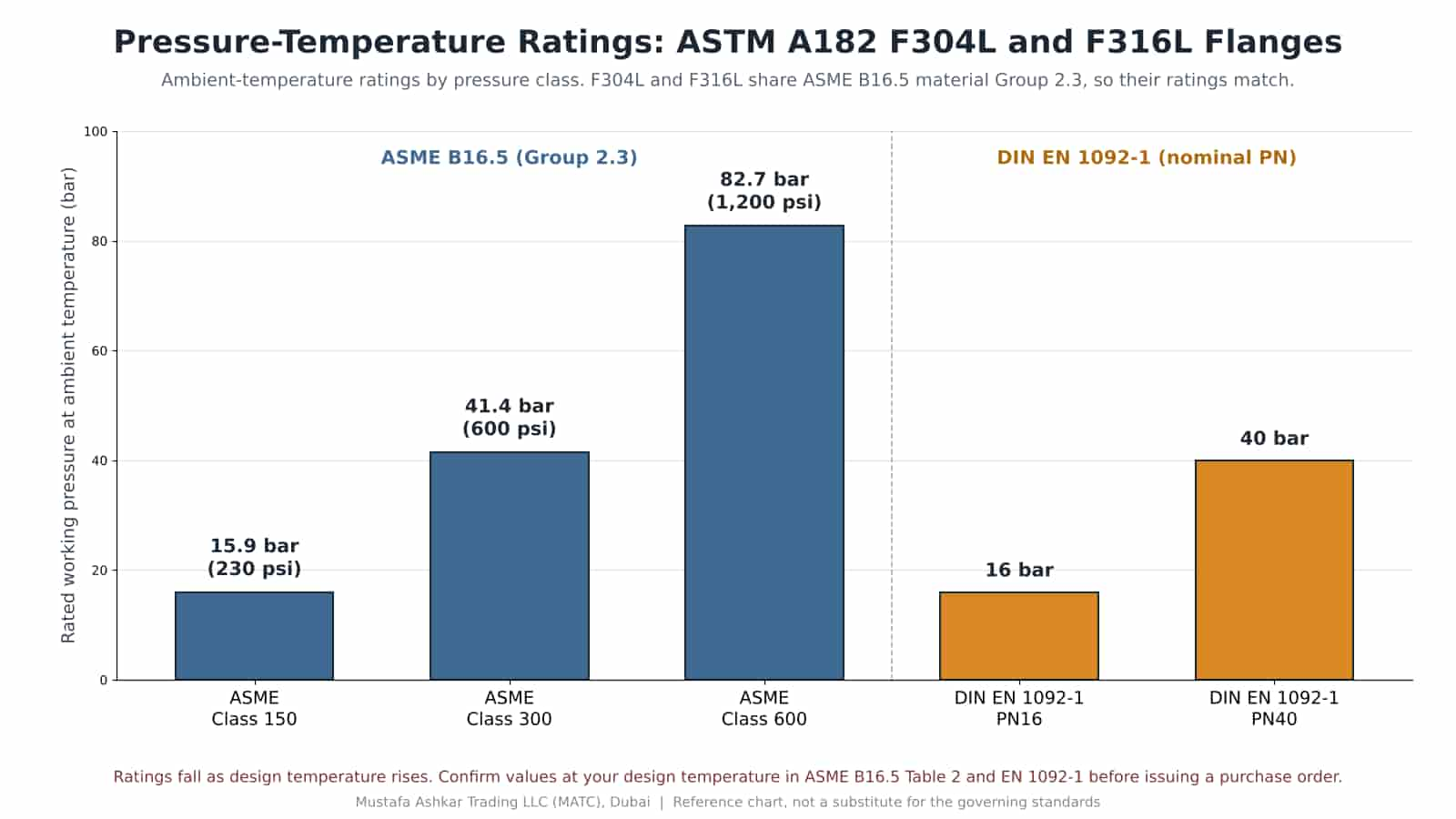
ASME B16.5 covers NPS 1/2 to 24 in Classes 150 to 2500, with Class 2500 limited to NPS 12, while ASME B16.47 Series A and B cover NPS 26 and larger. DIN EN 1092-1 defines PN6 to PN40, and JIS B2220 defines 5K, 10K, and 16K ratings.
Project data sheets often mix all three systems, so verify bolt-hole patterns before ordering ASME, DIN, and JIS industrial pipe flanges for one manifold. ASME and DIN patterns are not interchangeable.
Which Flange Type Suits Each Service?
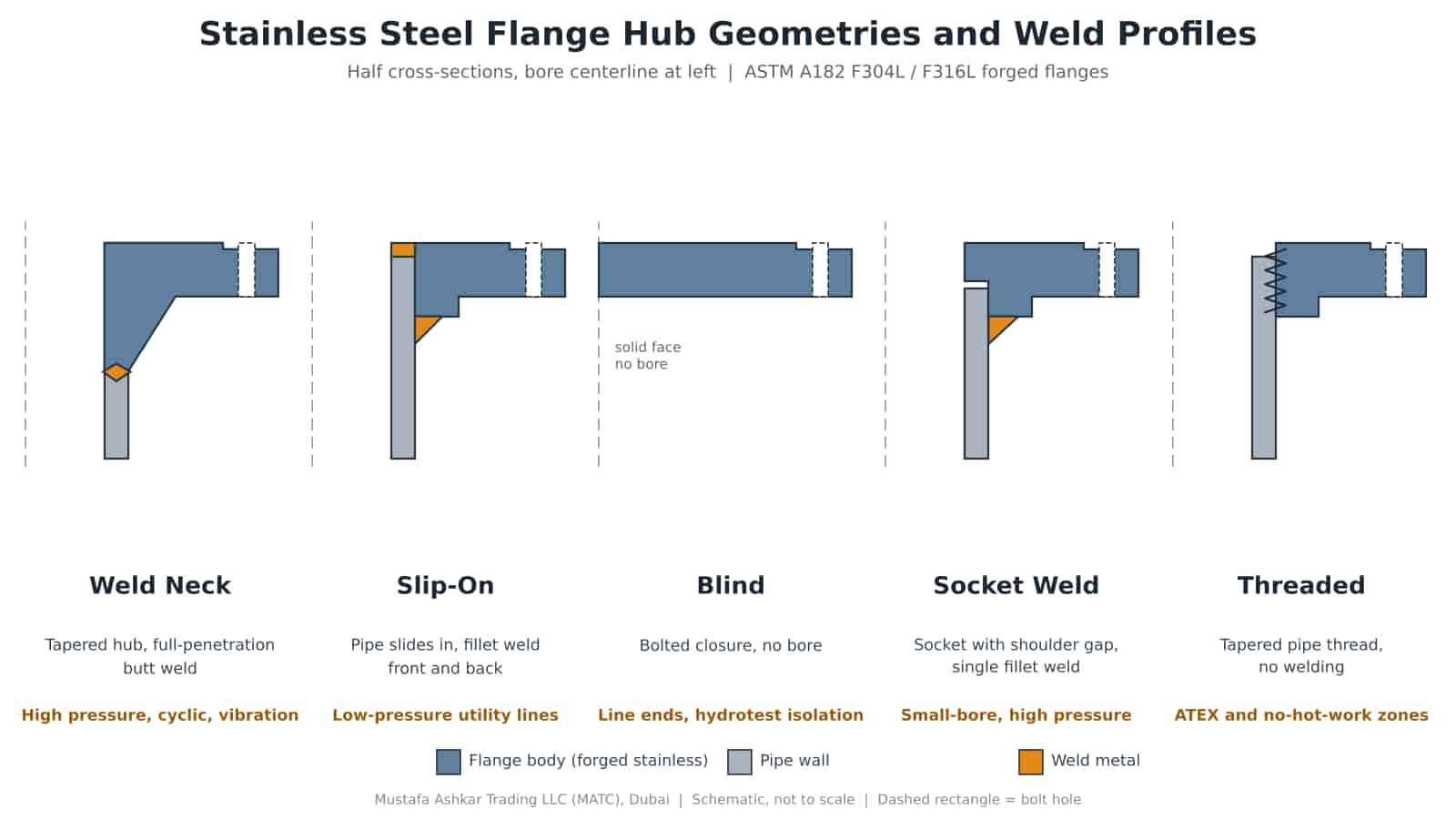
Weld Neck flanges suit high-pressure, cyclic, or vibrating lines because the tapered hub spreads stress into the pipe. Slip-On flanges suit low-pressure utilities, Blind flanges terminate lines and enable hydrotests, Socket Weld flanges serve small-bore high-pressure runs, and Threaded flanges avoid hot work in ATEX zones.
For sour oilfield and offshore headers, specify SS316 weld neck flanges Dubai stockists can supply with RF or RTJ facings, because Slip-On joints crack at the fillet weld under vibration.
Apply these facing and isolation rules:
- RF with spiral-wound or PTFE gaskets: standard chemical and utility lines.
- FF against cast or delicate faces: prevents flange bending under bolt load.
- RTJ with metal rings: high-pressure oilfield and hydrocarbon joints.
- Isolation sleeves and washers: stop galvanic attack against carbon steel.
| Flange type | Joint design | Pressure suitability | Facing | UAE application |
|---|---|---|---|---|
| SS Weld Neck | Tapered hub, butt weld | High-pressure, cyclic, hot | RF, RTJ | Oilfield headers, offshore |
| SS Slip-On | Double fillet weld | Low-pressure utilities | RF, FF | HVAC, water treatment |
| SS Blind | Bolted closure | Hydrotest, line end | RF, RTJ | Spools, pump isolation |
| SS Socket Weld | Single fillet weld | Small-bore, high-pressure | RF | Instrument, chemical lines |
| SS Threaded | No welding | Low-pressure, non-welded | RF, FF | ATEX zones |
Engineer’s tip: Before issuing your next RFQ for stainless steel flanges UAE sites require, verify dual ASTM A182 F316L certification, the RF versus RTJ facing finish, and the mating spiral-wound or PTFE gasket specification. Mustafa Ashkar Trading LLC’s Dubai desk can confirm these against warehouse stock.
Who Supplies Stainless Steel Flanges UAE Projects Need?
Mustafa Ashkar Trading LLC supplies stainless steel flanges UAE EPC teams can verify, from a 30,000+ sq. ft. Baniyas warehouse stocking NPS 1/2 to 24 with ISO 9001 quality control. Alternatives such as spot traders, overseas mills, and carbon-steel stockists each trade away certification, lead time, or stainless range.
As an industrial pipe fittings and flanges supplier in Dubai, MATC also stocks PTFE and spiral-wound gaskets, stainless steel butt weld and threaded pipe fittings, and offers custom oilfield fabrication with Emirates-wide logistics.
With 20+ years of trading, 200+ completed projects, and 3,000+ satisfied clients, MATC supports Dubai, Abu Dhabi, Sharjah, and wider GCC deliveries.
| Supplier | Stock and lead time | Certification | Range | Project fit |
|---|---|---|---|---|
| Mustafa Ashkar Trading LLC (MATC) | 30,000+ sq. ft. Dubai warehouse; NPS 1/2 to 24 stock | ISO 9001; EN 10204 3.1 MTCs | ASME, DIN, JIS; all five types; gaskets, fittings, fabrication | Emirates-wide dispatch |
| Uncertified spot-market traders | Variable, unverified lots | Missing heat-number traceability | Mixed grades, inconsistent facings | High rejection risk |
| Overseas direct forging mills | Long lead times, minimum orders | Full mill certificates | Strong range, custom forgings | Planned shutdowns only |
| Carbon-steel-only stockists | Fast carbon steel, no stainless depth | Limited stainless certification | Few F304L or F316L grades | Unsuitable for chloride service |
Overseas mills deliver excellent forgings but rarely match urgent shutdown schedules, while spot traders cannot supply heat-number traceability. Carbon-steel stockists lack the F316L depth that stainless steel flanges UAE chloride service demands.
What Is the 4-Step UAE Flange Protocol?
The 4-Step UAE Stainless Flange Specification and QA Protocol converts service conditions into a verifiable, auditable purchase order. Engineers define the chloride and temperature duty, lock the grade and standard, select type and facing, then audit certificates and dimensions before dispatch.
- Define duty: record chloride level, design temperature, pressure, and vibration.
- Lock grade and standard: call out ASTM A182 F316L, then the governing ASME B16.5 stainless steel flanges UAE rating or DIN EN 1092-1 stainless flanges UAE PN class.
- Select type and facing: match Weld Neck, Slip-On, Blind, Socket Weld, or Threaded to service, then confirm RF, FF, or RTJ and gasket.
- Audit before dispatch: compare heat numbers, chemistry, and dimensions against the EN 10204 Type 3.1 certificate.
How Do You Verify an MTC Before Shipment?
Verify an MTC for any stainless steel flanges UAE project by matching its heat number to the flange stamping, checking chemistry and mechanical results against ASTM A182 limits, and confirming dimensions to the ordered standard. Reject any certificate lacking molybdenum or carbon values, or showing mismatched heat numbers.
Use this pre-shipment checklist:
- Match heat numbers on stamping and certificate.
- Check chromium, nickel, molybdenum, and carbon (0.03% max for L grades).
- Measure OD, bolt circle, thickness, and facing finish.
- Inspect the gasket seating surface for scratches or pitting.
On site, tighten bolts in a star pattern across at least three passes, and fit isolation sleeves when mating stainless to carbon steel.
Final Specification Takeaways for Piping Teams
Choosing stainless steel flanges UAE projects can rely on means matching F316L chemistry, flange type, and traceable EN 10204 Type 3.1 documents to the service. Dubai stock removes import delays, and ISO 9001 controls keep dimensions and certificates consistent.
Ready to verify stock? Send your stainless steel flanges UAE MTO or schedule to the Mustafa Ashkar Trading LLC Dubai engineering desk for rapid stock verification, EN 10204 Type 3.1 documentation, and UAE and GCC dispatch.
Frequently Asked Questions on Stainless Flanges
Is SS316L better than SS304L for UAE coasts?
Yes. SS316L resists chloride pitting far better than SS304L because of its 2–3% molybdenum, making it the safer choice for coastal, offshore, and desalination service. SS304L remains acceptable for indoor, potable water, and HVAC lines where chloride exposure is consistently low and temperatures stay moderate.
When should I use Blind or Slip-On flanges?
Use Blind flanges to terminate lines, isolate equipment, and enable hydrotests. Use Slip-On flanges for low-pressure, non-cyclic utility lines where easier alignment matters. Source slip on and blind SS flanges Dubai stockists certify, and avoid Slip-On designs for vibrating or high-pressure hydrocarbon service.
What documents prove stainless flange quality?
An EN 10204 Type 3.1 Mill Test Certificate is the baseline for stainless steel flanges UAE buyers, listing heat number, chemistry, mechanical properties, and heat treatment for each flange. Add dimensional reports, PMI records, and hydrotest data when project specifications require them, and confirm the certificate references ASTM A182 and ASME B16.5.