
Common Pipe Fitting Failures in UAE: 6 Root Causes, Diagnostics and Prevention Guide
Common pipe fitting failures rarely begin with a dramatic rupture. They start as a weeping thread, a hairline crack at a thread root, or a gasket that no longer seats flat. In Dubai’s heat, humidity and salt-laden air, those small defects mature into shutdowns faster than most design assumptions allow.
This guide explains the six root causes behind common pipe fitting failures in UAE industrial, oil and gas, MEP, marine and facility management systems. Each section covers the mechanism, the operational impact and the preventive action. A diagnostic table and a six-gate reliability framework close the guide.
Table of Contents
- What Are the Most Common Pipe Fitting Failures in the UAE?
- How Does Over-Torquing Cause Thread Stripping?
- How Does Stress Corrosion Cracking Attack Fittings in Dubai?
- What Causes Water Hammer Fitting Damage?
- How Do Thermal Expansion and Vibration Fatigue Loosen Fittings?
- What Happens When Fitting Material or Pressure Class Is Mismatched?
- What Is Erosion-Corrosion and Cavitation in Fittings?
- How Do You Diagnose a Fitting Failure From Its Symptoms?
- What Is the Six-Gate Fitting Reliability Framework?
- Final Takeaways: Preventing Common Pipe Fitting Failures
- Frequently Asked Questions
What Are the Most Common Pipe Fitting Failures in the UAE?
The most common pipe fitting failures in the UAE are thread over-torquing, stress corrosion and galvanic attack, water hammer, thermal and vibration fatigue, pressure or material mismatch, and erosion-corrosion with cavitation. Most trace back to specification and installation decisions rather than manufacturing defects.
Dubai stacks several stressors on every joint at once. Summer air temperatures above 45°C, coastal humidity that often exceeds 80%, chloride-laden dust and saline sabkha soils all accelerate degradation. A fitting that performs for years in a temperate climate can age far faster here, which is why common pipe fitting failures cluster in this region.
The pipe fitting failure causes Dubai plants report most often are rarely exotic. Engineers see the same six mechanisms repeat across cooling-water loops, fire-fighting mains, compressed air headers and process lines. Understanding each one is the fastest route to industrial piping leaks prevention.
Each section below treats one of the common pipe fitting failures and follows one pattern: how the failure forms, what it costs the operation, and which engineering control stops it. Process piping rules such as ASME B31.3 anchor the guidance, and every limit should be verified against your project specification.
How Does Over-Torquing Cause Thread Stripping?
Over-torquing drives threads past their elastic limit, stripping thread flanks or opening micro-cracks at the thread root of cast, malleable and forged fittings. The damaged thread then leaks under pressure or fractures later under cyclic load, often weeks after commissioning, which makes it one of the most common pipe fitting failures.
Why Do Cast and Forged Fittings Crack When Over-Tightened?
Tapered threads such as NPT and BSPT seal by wedging the male thread into the female socket. Every extra turn raises hoop stress in the socket wall, and cast iron, malleable iron and brass bodies have little ductility to absorb it, so cracks start at the last engaged thread.
Of all common pipe fitting failures, this one is the least likely to show up immediately. A joint that passes a short hydrotest can still hold a hidden crack that grows under pressure cycling, vibration or thermal swing. Brass hex nipples and malleable elbows on compressed air and utility lines are typical casualties.
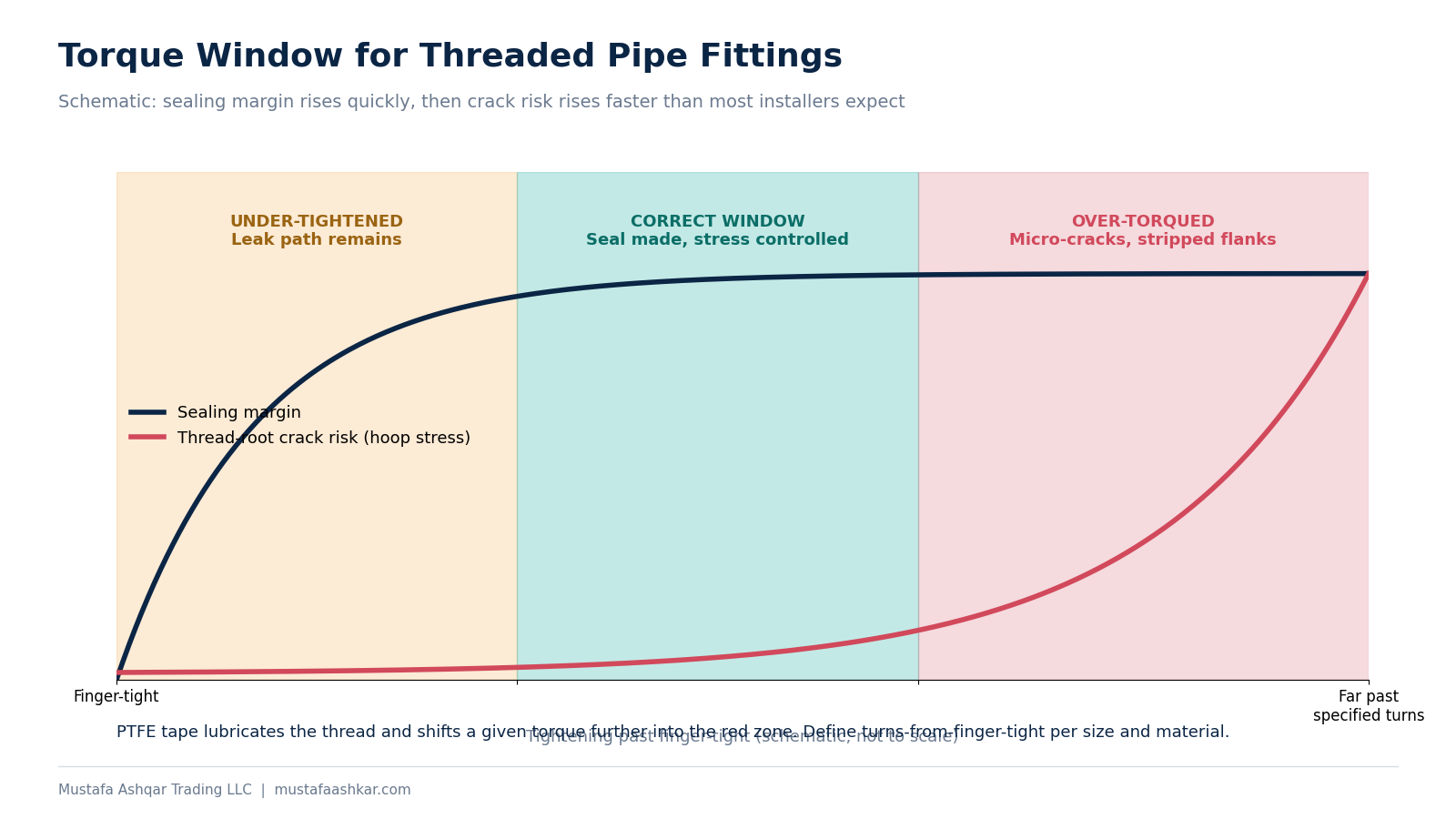
Flange joints suffer a parallel problem. Uneven bolt loading crushes gaskets and distorts sealing faces, so leaks appear even when every bolt feels tight. Staged, cross-pattern tightening in line with ASME PCC-1 practice avoids this class of common pipe fitting failures.
Should You Use PTFE Tape or Anaerobic Thread Sealant?
Use PTFE tape for general-purpose tapered metal threads in water and air, and anaerobic sealant where vibration, higher pressure or chemical exposure demands a locked, gap-filling seal. Tape lubricates the thread and invites over-tightening, while anaerobic sealant cures between metal surfaces and resists loosening.
Tape misuse causes two recurring faults among common pipe fitting failures. Excess wraps act as a wedge and split female sockets, and loose shreds travel downstream into valve seats and instruments. Never apply tape to parallel threads such as BSPP, which seal on a washer or bonded seal rather than on the thread flanks.
Anaerobic sealants cure in the absence of air and in contact with metal. They cure slowly on passive surfaces such as stainless steel unless an activator is used, and most should not touch thermoplastics, where stress cracking can follow. Confirm temperature, pressure and media limits on the product data sheet.
| Criterion | PTFE tape | Anaerobic sealant |
|---|---|---|
| Lubrication during assembly | High, raises over-torque risk | Low, torque stays controlled |
| Vibration resistance | Poor | Good, locks the thread |
| Contamination risk | Shreds can enter the system | Low once fully cured |
| Typical fit | Utility water and air, low-risk lines | Vibrating lines and chemical media, within data-sheet limits |
Thread standard mismatch compounds every sealing problem. Our guide to BSP versus NPT thread selection for Dubai projects shows how to gauge-check mixed stock before it reaches the installer.
How Do You Prevent Torque-Related Fitting Damage?
Prevent torque-related common pipe fitting failures by specifying a turns-from-finger-tight method, matching sealant to thread type, and training installers on the limits of each fitting material. Calibrated tools and a documented tightening procedure remove the guesswork behind most thread failures on site.
- Assemble finger-tight, then apply a defined number of turns for the size and material instead of tightening until the wrench stops.
- Tighten flange bolts with a calibrated torque wrench, in a cross pattern, across at least three passes.
- Keep one thread standard per line and gauge-check mixed BSP and NPT stock at receiving.
- Specify forged bodies from a supplier of industrial pipe fittings in UAE where rough handling is likely.
- Re-inspect threads after the first thermal cycle, not only after the hydrotest.
How Does Stress Corrosion Cracking Attack Fittings in Dubai?
Stress corrosion cracking occurs when tensile stress, a susceptible alloy and a corrosive environment act together, producing brittle cracks with little visible metal loss. In Dubai, chloride from coastal air, seawater and cooling water makes austenitic stainless steel especially vulnerable at elevated metal temperatures.
Among common pipe fitting failures, chloride stress corrosion cracking in 300-series stainless typically becomes a risk once metal temperature rises above roughly 50 to 60°C. Sun-exposed lines and hot process lines reach that range easily. Residual stress from threading, cold bending and welding supplies the tensile component.
Insulation makes these common pipe fitting failures worse. Moisture trapped under cladding concentrates chlorides against the metal surface, and the fitting cracks behind an intact jacket. Corrosion under insulation can hide stress corrosion cracking from a visual walk-down entirely.
What Drives Pitting and Crevice Corrosion in Coastal UAE?
Pitting and crevice corrosion are driven by chloride ions breaking down the passive film on stainless steel and by oxygen-starved gaps beneath gaskets, threads and deposits. High humidity, daily condensation and salt deposition in Dubai keep a conductive film on metal surfaces for much of the year.
Alloy selection is the first defence against common pipe fitting failures from pitting. The pitting resistance equivalent number, or PREN, ranks grades: 316L sits near 24, duplex 2205 near 35, and super duplex grades above 40. Pair that ranking with a realistic chloride and temperature profile, not a catalogue default.
Commissioning can introduce the damage. Chlorinated or brackish test water left standing in stainless fittings seeds pits and crevices before the plant starts, and much of the pipe fitting corrosion UAE sites report later traces back to it. Many specifications cap hydrotest chloride at 30 ppm and require full drainage.
How Does Galvanic Corrosion Attack Dissimilar Metals?
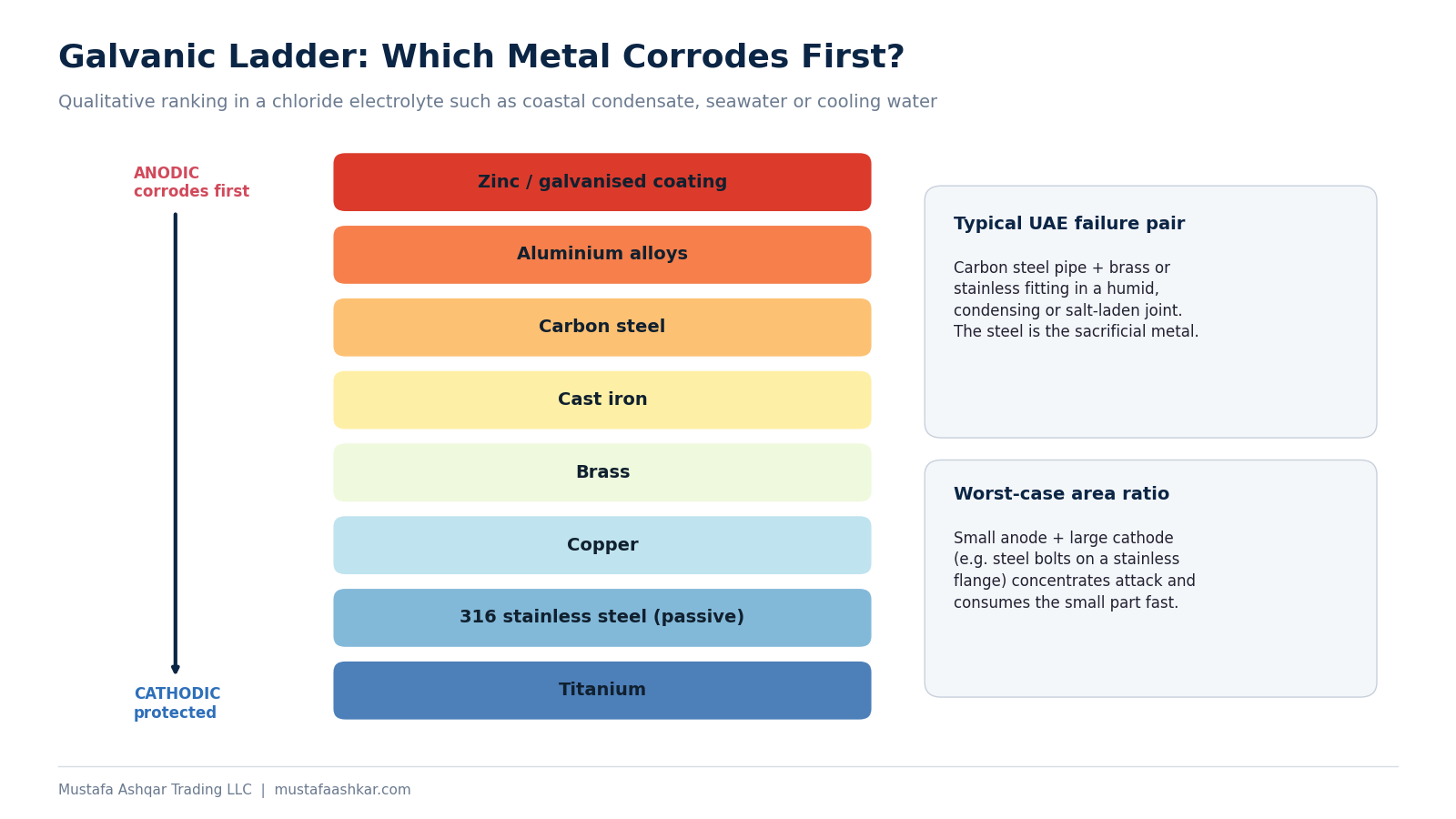
Galvanic corrosion occurs when two dissimilar metals touch in the presence of an electrolyte, and the more anodic metal corrodes faster to protect the more noble one. Carbon steel pipe joined to brass or stainless steel fittings in humid or condensing conditions is a typical UAE example.
The potential difference matters less than the electrolyte and the area ratio. A small anode coupled to a large cathode, such as carbon steel bolts on a stainless steel flange, concentrates attack and consumes the small part quickly. Brass-to-steel threaded joints on cooling-water lines make galvanic attack one of the most visible common pipe fitting failures.
How Do You Prevent Corrosion-Driven Fitting Failures?
Prevent corrosion-driven common pipe fitting failures by matching alloy grade to the chloride and temperature profile, isolating dissimilar metals, coating exposed carbon steel and eliminating water traps. Follow corrosion-control practice from bodies such as AMPP and verify it with scheduled inspection at the joints most likely to fail.
- Specify a higher-PREN or duplex grade for chloride-exposed, warm service.
- Fit isolation kits and non-conductive sleeves where steel meets copper alloys, and use industrial gaskets rated for the media.
- Seal insulation jackets, and inspect low points and penetrations for corrosion under insulation.
- Slope lines to drain, and remove dead legs where condensate collects.
- Use low-chloride hydrotest water, then drain and dry the system.
- Open sample brass-to-steel and stainless-to-steel joints at every shutdown to catch early attack.
Material check before you order. If you are finalising a specification for a coastal or chloride-exposed system, request a material compatibility review from our team. We will map your media, temperature and environment against the grades we can supply.
What Causes Water Hammer Fitting Damage?
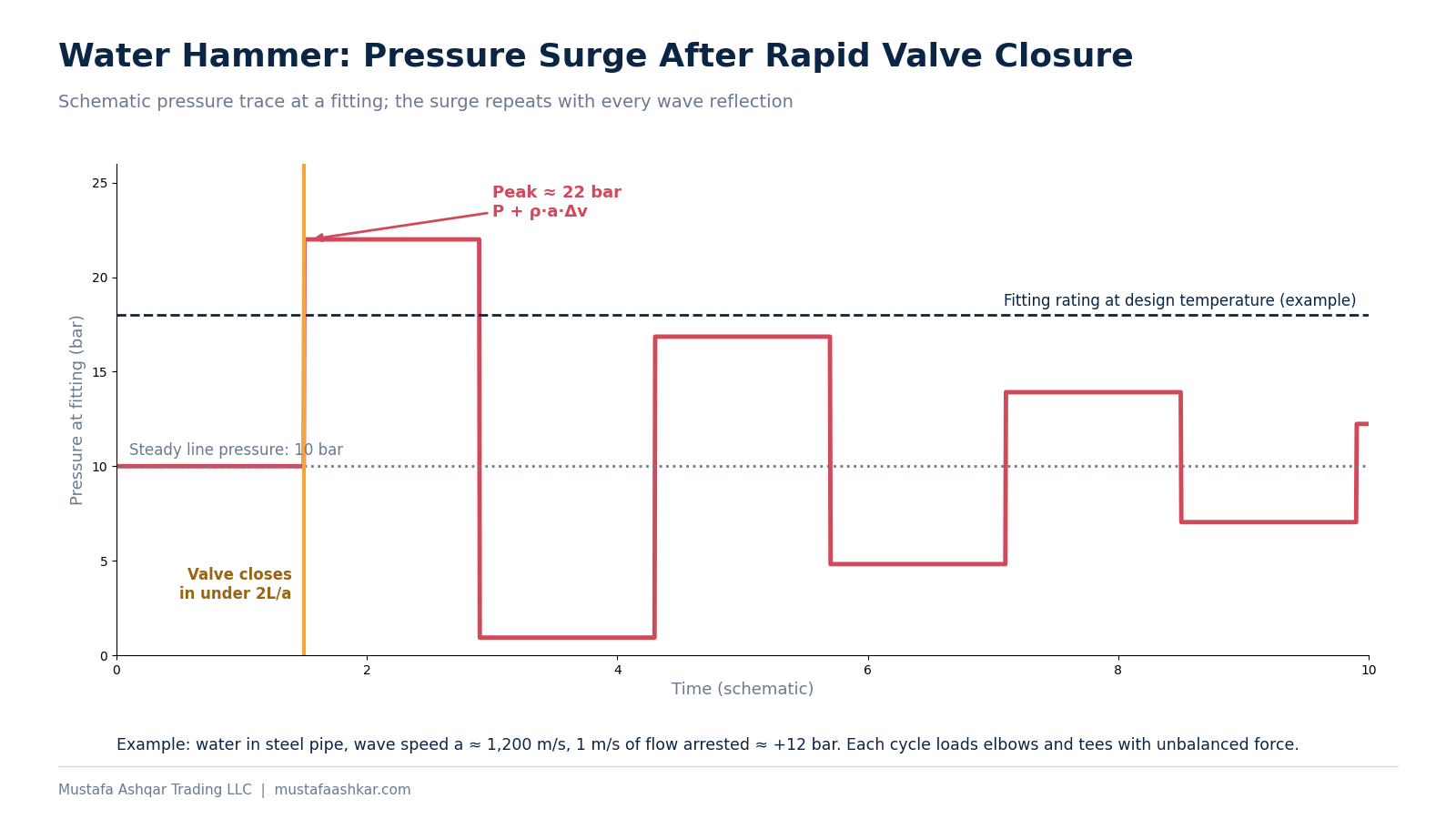
Water hammer fitting damage results from sudden pressure surges when flowing liquid is stopped or redirected faster than the system can relieve its momentum. Rapid valve closure, pump trips, check valve slam and trapped air pockets are the usual triggers, and elbows and tees absorb the resulting force.
The physics behind this group of common pipe fitting failures is direct. The Joukowsky relation, ΔP = ρ × a × Δv, gives the surge for an abrupt velocity change. In steel pipe carrying water, a wave speed near 1,200 m/s means each 1 m/s of arrested flow adds roughly 12 bar to line pressure.
Closure time decides whether that surge appears. A valve that closes in less than 2L/a, where L is the pipe length and a is the wave speed, behaves as an instantaneous closure. Longer closure spreads the deceleration and lowers the peak.
How Does a Pressure Surge Fatigue Elbows and Tees?
Surges create unbalanced momentum forces at every change of direction, so elbows and tees see the highest cyclic loads in these common pipe fitting failures. Repeated pressure spikes initiate fatigue cracks at thread roots, weld toes and socket welds, and they gradually loosen threaded joints and flange bolting.
Air complicates the picture. Entrapped air pockets compress and then collapse, which accelerates slugs of liquid into closed valves and bends. Column separation, where pressure drops to vapour pressure and the void later collapses, can produce surges larger than the initial event.
How Do You Control Water Hammer in Industrial Piping?
Control water hammer, one of the more destructive common pipe fitting failures, by lengthening valve closure time, softening pump starts and stops, venting air, and installing surge protection where transient analysis shows it is needed. Support and restrain elbows and tees so that any residual surge moves the pipe less and loads the joints less.
- Specify actuated valves with closure times well above 2L/a, for example cast steel valves fitted with speed-controlled actuators.
- Use variable-speed drives or soft starters, and non-slam check valves on pump discharge lines.
- Fit air-release valves at high points and fill lines slowly.
- Add surge vessels or relief devices where analysis shows pressure above fitting ratings.
- Restrain elbows and tees with guides and anchors sized for transient thrust.
Supplier choice matters as well. Our guide to choosing the best valve suppliers in UAE for industrial applications lists what to verify before you buy check valves and isolation valves for surge-sensitive lines.
How Do Thermal Expansion and Vibration Fatigue Loosen Fittings?
Thermal cycles make pipe and fittings grow and shrink at different rates, while vibration adds high-frequency cyclic stress. Together they drive some of the most persistent common pipe fitting failures: loosened threads, fatigued small-bore connections and cracked welds, especially near unanchored pumps and compressors and on sun-exposed UAE pipe racks.
How Much Does Pipe Expand in UAE Heat?
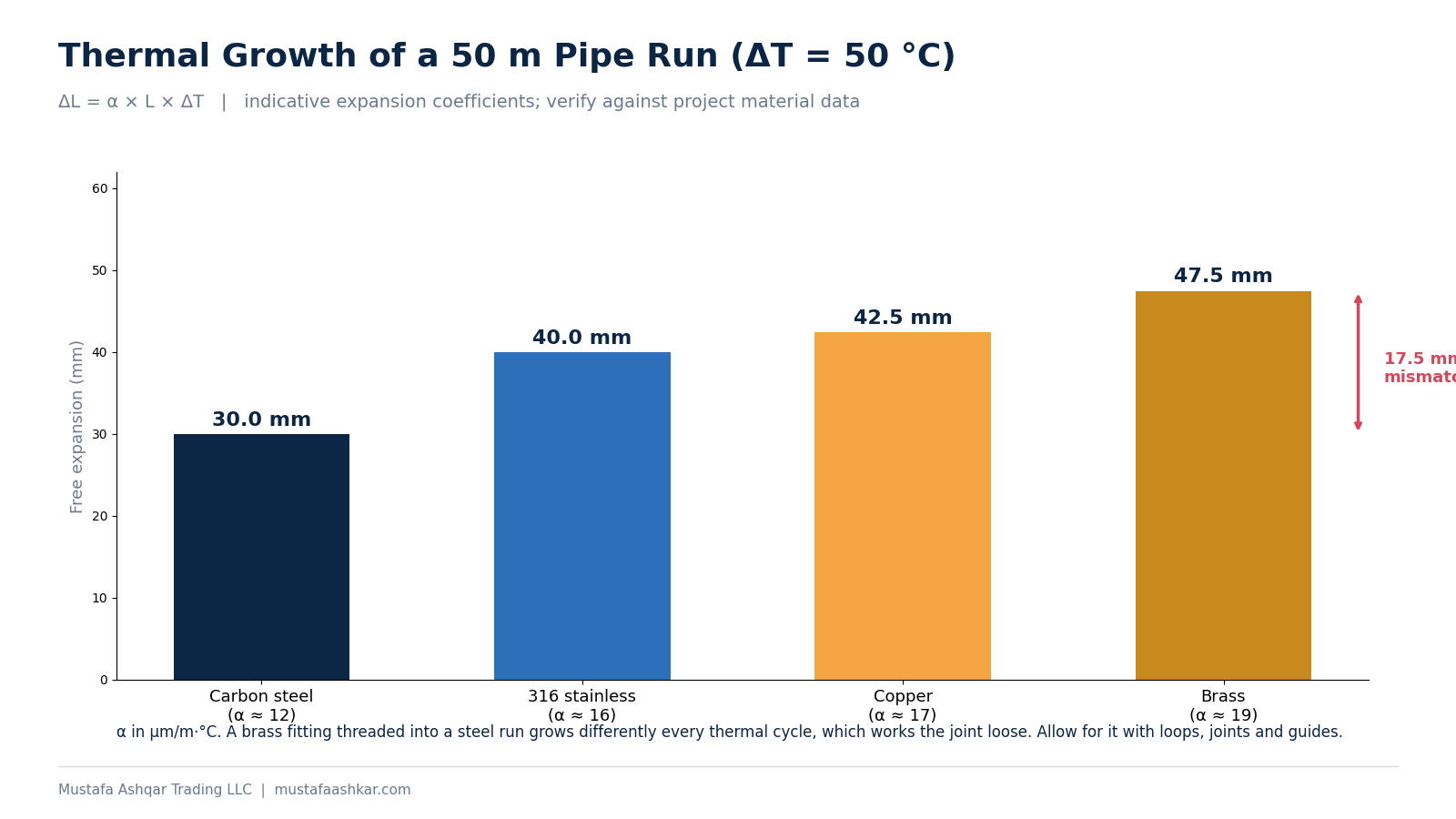
Free expansion equals the expansion coefficient multiplied by pipe length and temperature change. A 50 m carbon steel run heated by 50°C grows about 30 mm, and stainless steel, copper and brass grow even more under the same conditions, so unmanaged growth quietly feeds common pipe fitting failures.
Mismatch is the quieter problem. A brass fitting threaded into a steel run expands more than its host on every cycle. Over hundreds of cycles the joint works loose, and the sealant bond fatigues.
Allow for movement deliberately. Expansion loops, bellows or expansion joints, and correctly placed guides and anchors route growth away from threaded joints. Sun-exposed lines should be designed for surface temperatures well above ambient air temperature.
How Does Vibration Break Small-Bore Fittings?
Machine vibration excites small-bore branches, drains and instrument connections, which are light, unsupported and often threaded. Resonance drives high-cycle fatigue at the first or last engaged thread, where stress concentrates, and cracks form without any pressure excursion, which makes vibration a quiet driver of common pipe fitting failures.
Assess these connections early. The Energy Institute publishes guidelines for avoiding vibration-induced fatigue in process pipework, and ISO 20816 sets machine vibration severity limits. Both give you a screening method before a crack appears.
- Anchor pumps and compressors on rigid, grouted baseplates and check alignment.
- Brace small-bore branches to the main line with gusseted supports.
- Specify compressor fittings and instrumentation fittings suited to cyclic service.
- Use locking sealants or lock wire on threads in vibrating service.
What Happens When Fitting Material or Pressure Class Is Mismatched?
A mismatched fitting operates outside its pressure-temperature envelope or its chemical compatibility, so it bulges, leaks or corrodes through the wall. These failures are entirely preventable because they originate at the specification stage, not in service, yet they remain among the common pipe fitting failures in site audits.
Is Class 150 Interchangeable with Class 3000?
No. Class 150 describes flanged components under ASME B16.5, while Class 3000 describes forged threaded and socket-weld fittings under ASME B16.11, and the two are not directly comparable. Always read the allowable pressure at design temperature, because ratings fall as temperature rises.
A Class 150 flange in group 1.1 carbon steel carries about 19.6 bar at ambient but only about 13.8 bar at 200°C. Buyers who compare class numbers alone can install a fitting that looks safe on paper and is underrated at operating temperature.
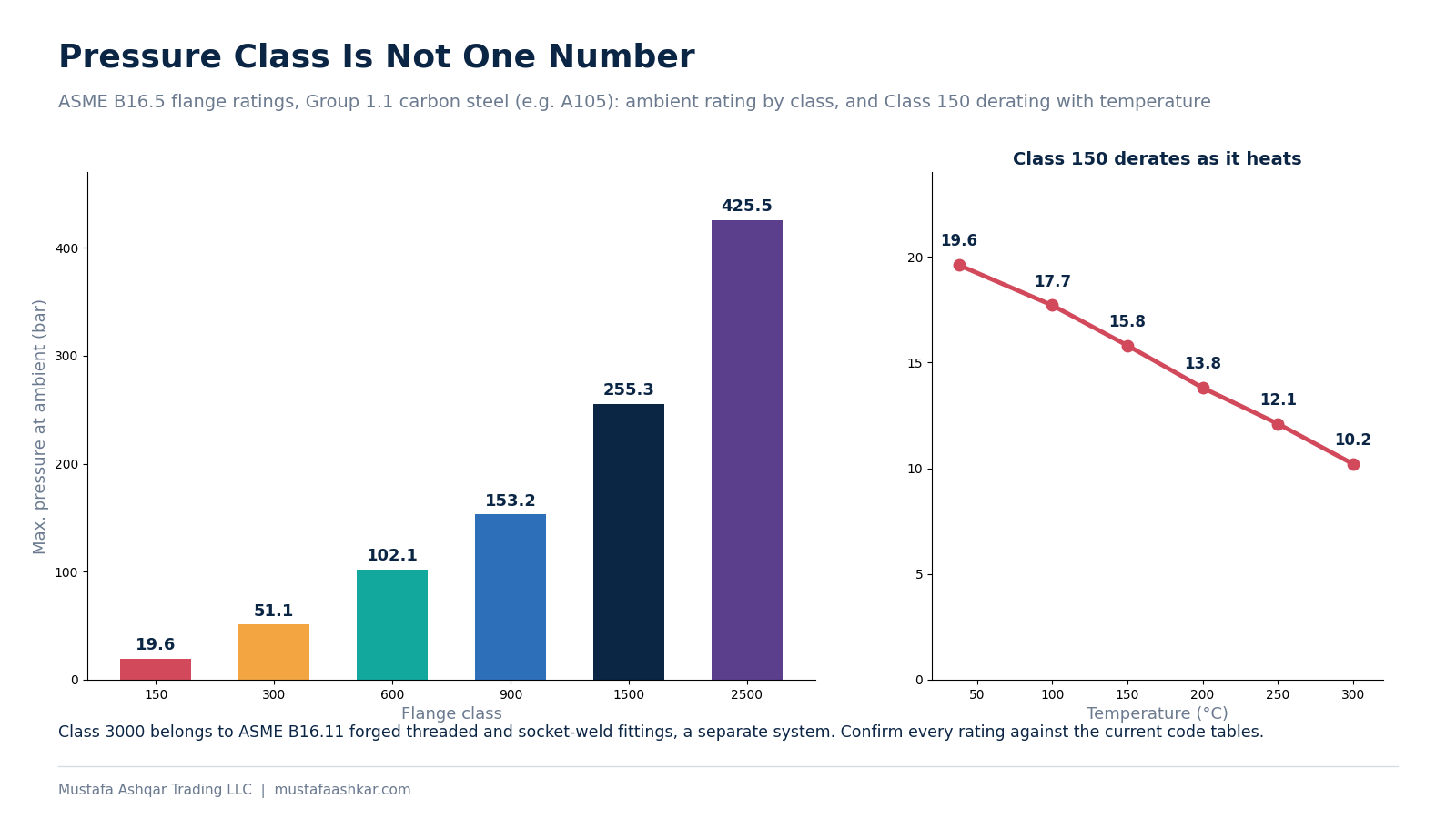
Verify the rating of every component in the joint to avoid common pipe fitting failures at the interface. The weakest element, whether flange, bolt, gasket or threaded nipple, sets the allowable pressure. Matching carbon steel and stainless steel flanges with the right fittings keeps the whole assembly at one rating.
How Do You Match Alloys to Aggressive Media?
Match alloys by listing the media, concentration, temperature and contaminants, then checking each against the material’s corrosion data. Do not assume stainless steel resists everything: chlorinated water, acids and hypochlorite attack common grades, while sour service requires compliance with NACE MR0175 and ISO 15156.
- Request EN 10204 3.1 mill certificates and keep heat numbers traceable to the installed fitting.
- Use positive material identification on receipt to catch alloy grade mix-ups.
- Check elastomer and gasket compatibility as carefully as metal compatibility.
- For flexible lines, confirm working pressure, burst safety factor and chemical compatibility on the data sheet of the high-pressure industrial hoses you select.
What Is Erosion-Corrosion and Cavitation in Fittings?
Erosion-corrosion is accelerated metal loss caused by fast, turbulent or particle-laden flow that strips protective films from the wall. Cavitation is damage from vapour bubbles collapsing against the surface after a local pressure drop. Both thin fitting walls from the inside, where inspection rarely looks, which is why these common pipe fitting failures surprise operators.
Why Do Elbows Wear Out Faster Than Straight Pipe?
Elbows redirect flow, so fluid and entrained solids strike the outer wall at full velocity and turbulence is highest there. That impact removes protective oxide films, and corrosion then attacks fresh metal, thinning the outer radius faster than any straight run.
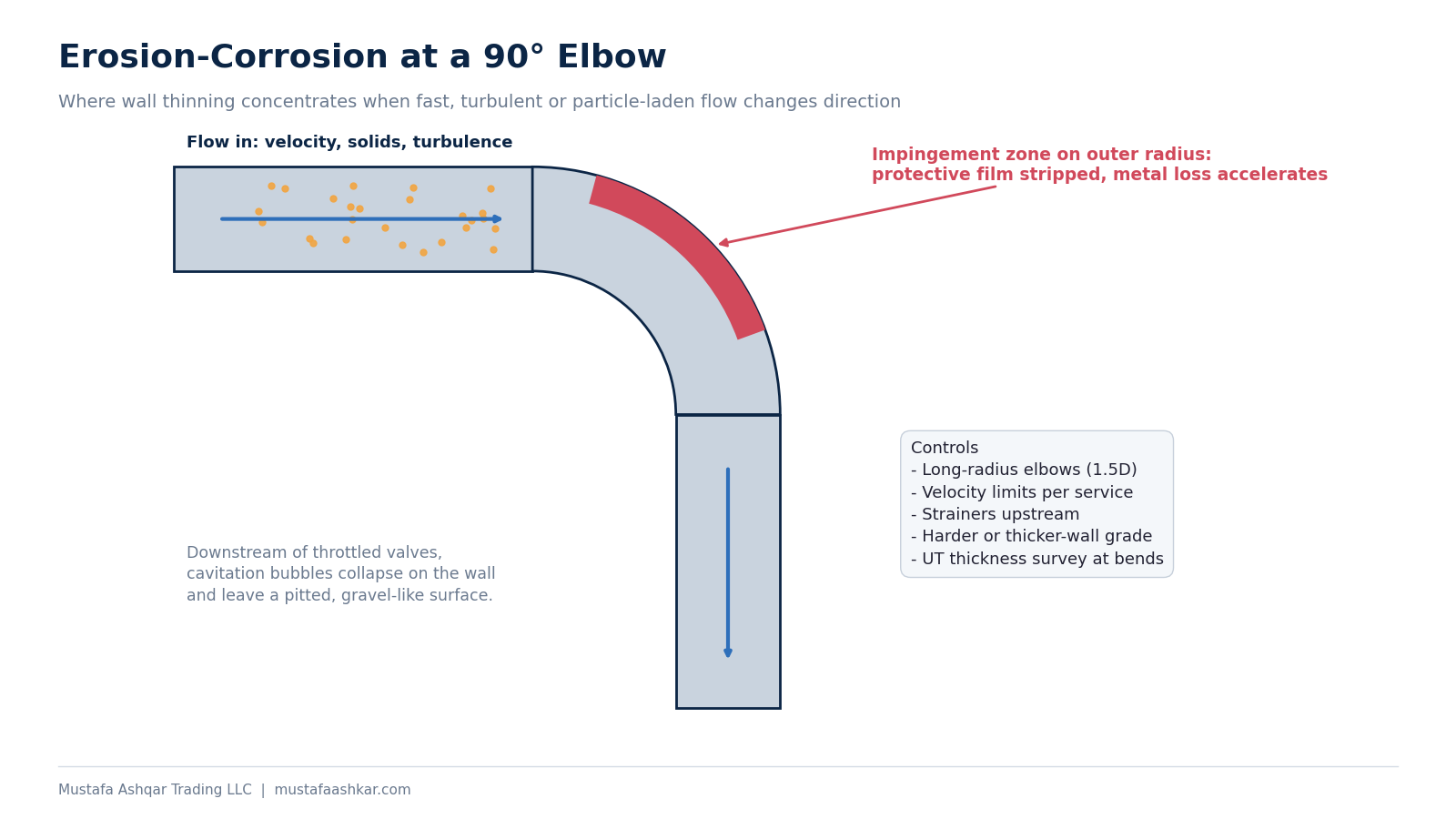
Sand, welding slag and construction debris left from commissioning act as abrasives and turn erosion into one of the common pipe fitting failures operators miss. Short-radius elbows, sharp tees and partially closed valves concentrate the effect. Velocity limits depend on material and service, and API RP 14E style erosional velocity checks help for multiphase lines.
Use long-radius elbows, install strainers upstream of sensitive fittings, flush systems before startup, and schedule ultrasonic thickness readings on outer radii. Upgrade to a harder alloy or thicker wall where velocity cannot be reduced. Our carbon steel pipe problem-solving guide covers wall-thickness trade-offs.
What Does Cavitation Damage Look Like in a Fitting?
Cavitation damage appears as a pitted, gravel-like or spongy surface downstream of valves, orifices and pump inlets. It occurs when local pressure falls below the liquid’s vapour pressure, forming bubbles that collapse violently against the wall and fatigue the metal surface.
Among common pipe fitting failures, cavitation needs a pressure fix, not a metallurgy fix. Maintain adequate NPSH margin on pumps, avoid throttling with isolation valves, use anti-cavitation trim on control valves and keep adequate back-pressure downstream of pressure drops. Harder alloys only delay the damage.
How Do You Diagnose a Fitting Failure From Its Symptoms?
Diagnose common pipe fitting failures by matching the visible symptom to its likely root cause before replacing the part. Replacing a fitting without correcting the cause only resets the failure clock. The table below links each symptom to its cause and the corrective action.
| Failure symptom | Likely root cause | Actionable solution |
|---|---|---|
| Weeping thread within weeks of commissioning | Over-torque or wrong sealant | Replace the fitting, gauge-check the thread, set a turns-from-finger-tight method |
| Hairline crack at the last engaged thread | Over-torque or vibration fatigue | Replace, brace small-bore branches, review thread sealant |
| Branching cracks with little wall loss in stainless steel | Chloride stress corrosion cracking | Upgrade grade, remove tensile stress, inspect under insulation |
| Pits and rust bloom at gasket faces or thread crevices | Pitting and crevice corrosion | Raise PREN, eliminate gaps, use low-chloride test water |
| One metal wasting next to another at a joint | Galvanic corrosion | Isolate the metals, fix the area ratio, coat the cathode |
| Bangs, pipe movement, cracks at elbows and tees | Water hammer | Lengthen closure time, vent air, restrain the pipe |
| Repeatedly loosening threads near a pump | Thermal cycling or vibration | Add expansion paths, anchor equipment, use locking sealant |
| Bulged body or gasket blowout at a flange | Pressure class or material mismatch | Re-verify the class at temperature, replace the weakest component |
| Thin outer elbow wall or pitted surface after a valve | Erosion-corrosion or cavitation | Reduce velocity, fit long-radius elbows, fix the pressure drop |
What Is the Six-Gate Fitting Reliability Framework?
The Six-Gate Fitting Reliability Framework is a pre-commissioning checklist that tests each critical joint against the six families of common pipe fitting failures: specification, isolation, torque, surge, movement and flow. A joint must pass all six gates before release, because one failed gate leaves a known failure path open.
| Gate | Check | Pass criterion | Failure prevented |
|---|---|---|---|
| 1. Specification | Class, alloy, sealant and elastomer match the service | Rating verified at design temperature, certificate on file | Material and pressure mismatch |
| 2. Isolation | Dissimilar metals and chloride exposure reviewed | Isolation fitted or grade upgraded, no water traps | Galvanic attack and SCC |
| 3. Torque | Tightening method defined | Turns or torque recorded, sealant matched to thread | Thread stripping and micro-cracks |
| 4. Surge | Closure time and air venting reviewed | Closure above 2L/a or surge device fitted | Water hammer fatigue |
| 5. Movement | Expansion paths and vibration sources checked | Guides, loops and bracing in place | Thermal and vibration fatigue |
| 6. Flow | Velocity, solids and pressure drops checked | Within limits, strainers fitted, system flushed | Erosion-corrosion and cavitation |
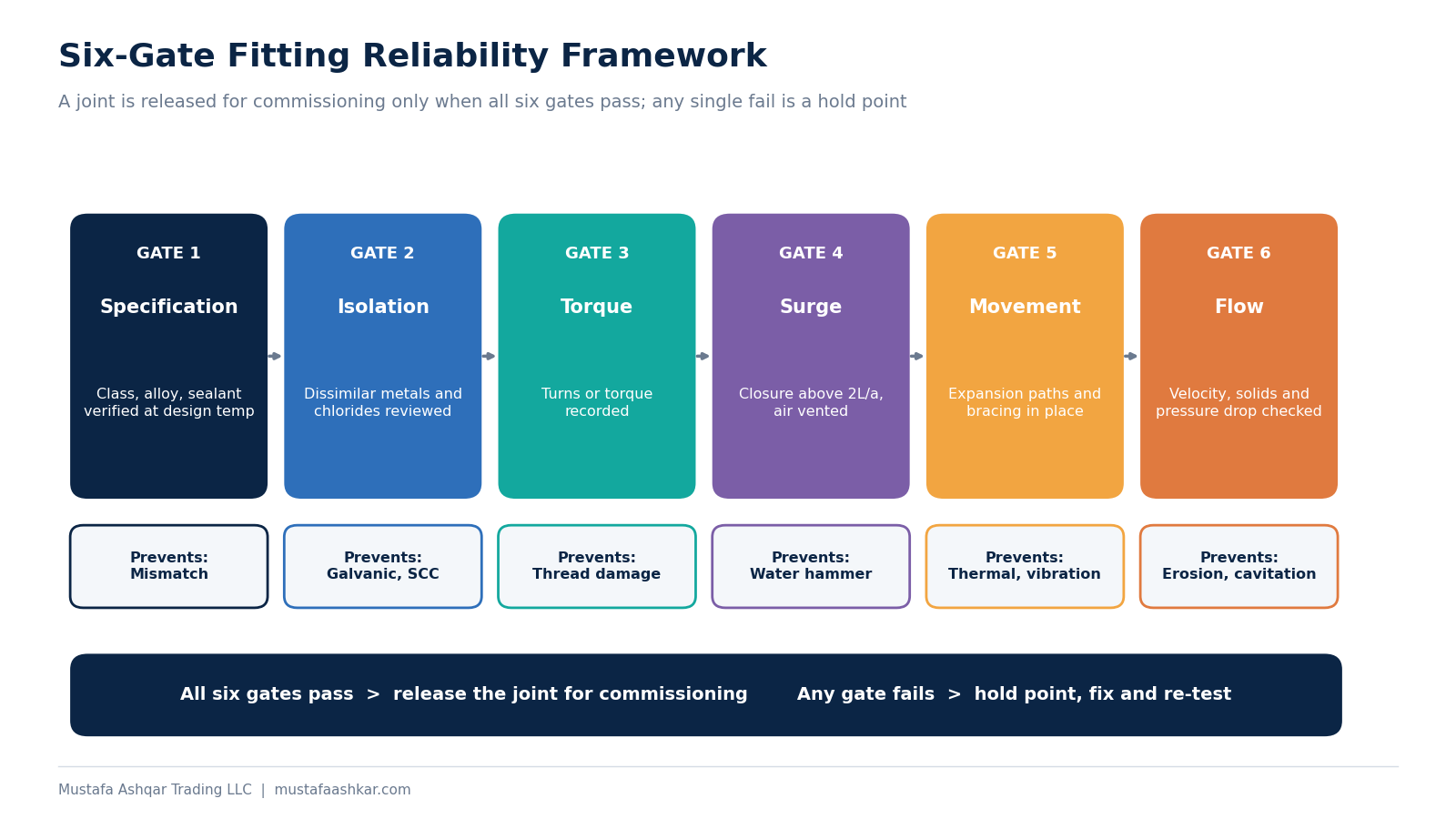
Score each joint pass or fail, and record the evidence. Treat a failed gate as a hold point, not a punch-list note. Re-run the six gates after any change in service temperature, media or flow rate.
Gates 1 and 2 depend on what you buy. Mustafa Ashqar Trading LLC supplies pipe fittings, valves, flanges and hoses, including stainless steel valves, so specification and isolation decisions can be made against real stock and real data.
Final Takeaways: Preventing Common Pipe Fitting Failures
Common pipe fitting failures follow patterns, and every pattern has an engineering control. Over-torquing, corrosion, surge, movement, mismatch and erosion each leave recognisable evidence long before a leak, if inspections look in the right place.
For UAE operators tackling common pipe fitting failures, the priority order is clear. Fix specification and isolation first, control installation torque and surge second, and manage movement and flow velocity third. Industrial piping leaks prevention then becomes a repeatable process rather than a reaction to the next outage.
Book a fitting specification review. Share your service conditions with the team at Mustafa Ashqar Trading LLC, and we will help you match fittings, valves, flanges and hoses to your environment. Talk to our team about pipe fittings supply in Dubai, call +971 4 227 9552 or email info@mustafaashkar.com.
Frequently Asked Questions
What is the most common cause of pipe fitting failure?
Installation error drives most common pipe fitting failures, led by over-tightened threads and poorly chosen sealants, with corrosion from incompatible materials close behind. In UAE conditions, corrosion often compounds installation damage because micro-cracks and crevices trap moisture and chlorides, and the two mechanisms then work together.
How can you prevent industrial piping leaks?
Industrial piping leaks prevention starts with the right material and pressure class, a documented tightening method, isolated dissimilar metals, controlled surges and supported pipe. Hydrotest every joint, then inspect high-risk joints at each shutdown to catch common pipe fitting failures early.
Why do pipe fittings corrode faster in Dubai?
Dubai’s high humidity, coastal chlorides, daily condensation and high surface temperatures keep a conductive film on metal for much of the year. These conditions accelerate pitting, crevice and galvanic corrosion, especially at joints between dissimilar metals, in threaded connections or beneath insulation.